Which Hand Should You Wear Your Golf Glove On?
If you’re new to golf—or simply double-checking your setup—one of the most common questions is surprisingly fundamental: Which hand does the golf glove actually go on?
The short answer comes down to whether you are right-handed or left-handed:
Right-handed golfers wear a glove on their Left hand (the lead hand).
Left-handed golfers wear a glove on their Right hand (the lead hand).
Here is a quick look at why we wear a glove on our lead hand, when golfers wear two gloves, and how to make sure you get the right fit.
Why Do You Wear a Glove on Your Lead Hand?
In a standard golf swing, your lead hand (the hand closest to the target) sits at the top of the grip and does the heavy lifting when controlling the clubhead throughout the swing.
Maximum Friction & Control: The top hand maintains the strongest structural hold on the club handle. Wearing a glove on this hand creates maximum friction between your skin and the rubber grip, preventing the club from twisting at impact.
Preventing Blisters: Because your lead hand takes the brunt of the grip pressure and torque, a high-quality leather glove acts as a protective layer, preventing friction blisters across the palm and fingers.
Relaxed Grip Pressure: When your lead hand has a secure grip thanks to a tour-grade glove, you don't need to squeeze the club tightly. Lighter grip pressure keeps your forearms and shoulders relaxed, leading to smoother tempo and increased clubhead speed.
Why Your Trail Hand Stays Bare
Your trail hand (the right hand for a righty, left hand for a lefty) sits below your lead hand on the grip.
Most golfers leave this hand ungloved because it acts as the "feeling" hand—responsible for subtle touch, control, and feedback, particularly around the greens during short game shots and putts.
When Should You Wear Two Golf Gloves?
While wearing one glove on the lead hand is the standard for dry weather, there are two main scenarios where wearing gloves on both hands makes perfect sense:
In Wet & Rainy Conditions: When playing on the West Coast of Ireland in a sudden downpour, rain gloves or high-performance all-weather gloves worn on both hands keep your grip completely locked in, even when the handles are soaking wet.
Cold Winter Rounds: In low temperatures, wearing winter golf gloves on both hands retains body heat, keeping your fingers flexible and preventing that painful sting on off-center hits.
Putting: Glove On or Off?
Should you take your glove off when you reach the green?
Glove Off: Many golfers prefer taking their glove off to putt to maximize feel and feedback through their fingers.
Glove On: Others keep it on simply for convenience and consistency.
There is no strict rule—it comes down to personal preference. Try both on the practice green to see what feels most natural to you.
Summary: Quick Buying Checklist
When ordering your glove online:
Right-Handed Golfer? Select a Left Hand (LH) glove.
Left-Handed Golfer? Select a Right Hand (RH) glove.
At Moher Golf, our Element 18 glove is engineered for maximum grip, feel, and durability in all weather conditions—giving your lead hand the ultimate connection to the club on every shot.
Why Is Your Golf Glove Wearing Out in the Palm? (And How to Fix It)
If you’ve ever pulled a relatively new golf glove out of your bag only to find the palm material fraying, thinning, or tearing open along the seam, you’re not alone.
It’s one of the most common issues golfers encounter. Whether you play with a premium Cabretta leather glove or a high-performance all-weather design, seeing palm wear after just a few rounds can be frustrating.
The good news? A torn palm isn’t a mystery, nor is it a sudden quality failure. Your golf glove leaves a story of every swing you take—and a hole in the palm is almost always telling you the exact same thing: micro-movement and friction.
Here is what causes premature palm wear and how a quick check of your grip and sizing can double the lifespan of your gloves.
1. The Mechanics: Friction Creates Wear
For leather or synthetic fabric to tear or peel, there has to be friction. And for friction to exist, two surfaces must move against each other.
When your grip on the golf club is locked in correctly, your lead hand, glove, and club handle move as a single unit throughout the entire swing.
However, if the club handle shifts or twists inside your hand—even by a fraction of a millimetre—it creates repeated friction right against the palm material. Over 70 to 90 swings a round (plus your practice swings), that subtle rubbing acts like sandpaper, rapidly wearing down the surface.
2. Cause #1: Holding the Club Too Much in the Palm
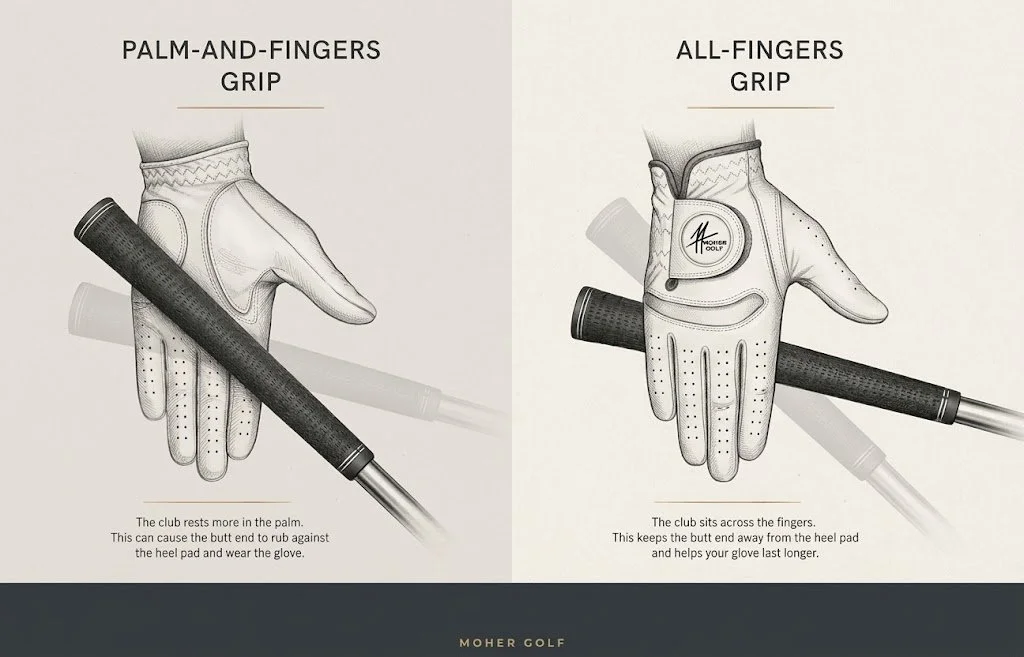
The single biggest contributor to palm wear is where the club rests across your lead hand at address.
In the Palm: If the handle sits high across the main cushion or center of your palm, the butt end of the club sits right against the palm seam. During the transition at the top of your backswing and down through impact, the heavy force of the clubhead causes the handle to slide against that exact spot.
In the Fingers: A fundamental golf grip places the club diagonally across the base of your fingers, resting just beneath the pad of your hand.
When the club rests through your fingers, your hand naturally secures the grip without requiring extra squeeze. This keeps the butt end of the club stable and completely away from the center palm seam.
3. Cause #2: Re-Gripping or Letting Go at the Top
Another common cause of palm friction is a slight "re-grip" at the top of the backswing.
If you loosen your fingers slightly as the club changes direction at the top of the swing and then clamp back down on the way into impact, the club handle rotates against the glove material under heavy load. Maintaining consistent, steady grip pressure from address to the finish keeps the glove locked onto the rubber grip.
4. Cause #3: Sizing — Is Your Glove Too Loose?
Your golf glove should fit like a second skin.
If there is any excess material or bunching across the palm when you make a fist, that loose fabric gets caught, pinched, and pulled between your hand and the club handle during the swing.
How a tight glove protects itself: When a glove fits snugly with zero slack, the fabric stays completely flush against your skin, eliminating the rubbing action that causes peeling or tearing.
Fit check: When pulling the velcro tab across, it should comfortably cover about 75% of the patch. If the tab pulls all the way past the edge easily, your glove may be a size too large.
Quick Summary: How to Maximize Glove Lifespan
Check Your Placement: Rest the club handle diagonally across the base of your fingers rather than high across the middle of your palm.
Keep It Snug: Always choose a size that feels comfortably tight with no loose fabric across the palm crease.
Dry It Out Properly: After a damp round on the course, let your glove air-dry flat naturally. Avoid stuffing it into the bottom of your bag or placing it on direct heat, which can dry out Cabretta leather or weaken lamination layers.
At Moher Golf, we design our gear to handle tough playing conditions along the West Coast of Ireland. By pairing tour-grade materials with a proper fit and grip, your gear will perform round after round—whatever the weather throws at you.
Clare-based Moher Golf launches all-weather glove
It All Begins Here
A NEW golf brand rooted on the Clare coastline is taking on the Irish golf market with a product designed specifically for the unpredictable weather of the Wild Atlantic Way. Moher Golf, founded by Ross Keyes and based near the Cliffs of Moher, has opened pre-sales of its debut product, the Element 18 – an all-weather performance golf glove designed to hold up through sun, hail, rain, wind and everything in between. The idea grew from a frustration shared by golfers across the west coast: most gloves on the market are built for dry climates and quickly lose grip, stiffen or deteriorate once Irish conditions kick in. Moher Golf set out to create a glove that performs on the kind of days Lahinch and the Cliffs of Moher are famous for. The Element 18 features Moher Golf's Box-Structure Palm Matrix, a design the company says delivers consistent grip in wet and windy conditions without losing shape or drying out. The brand's positioning is built around a simple idea: four seasons, eighteen holes, one glove. Moher Golf is based in County Clare and draws its identity directly from the west coast golf scene, with plans to expand its product range and community initiatives. The brand currently ships within Ireland and aims to build a wider community around Moher Golf in the coming months. Pre-orders and more information are available at mohergolf.com, with an official launch planned for September to coincide with the Irish Open at Doonbeg.
*Clare Echo 06/08/2026